




AI SDR tools can automate much of the repetitive work involved in sales development, including prospect research, outreach, follow-ups, lead qualification, and meeting scheduling.
- What Are AI SDR Tools?
- How Do AI SDR Tools Work?
- 1. Define the Ideal Customer Profile
- 2. Build a Prospect List
- 3. Research Each Prospect
- 4. Create Personalized Outreach
- 5. Send Follow-Ups
- 6. Handle Replies
- 7. Schedule Meetings
- What Can an AI SDR Actually Do?
- Prospecting
- Lead Qualification
- Sales Research
- Email Creation
- Outreach
- Reply Classification
- Meeting Scheduling
- CRM Administration
- AI SDR Tools vs. Human SDRs
- AI SDR Tools vs. AI Sales Assistants
- Key Features to Check Before Choosing a Tool
- 1. Data Quality
- 2. Personalization
- 3. CRM Integration
- 4. Email Controls
- 5. Human Approval
- 6. Reply Handling
- 7. Analytics
- Benefits of AI SDR Tools
- Less Repetitive Work
- Higher Outreach Capacity
- Faster Responses
- Better Use of Sales Time
- Support for Small Teams
- Where AI SDR Tools Still Have Limits
- Bad Data Creates Bad Outreach
- AI Can Misread Context
- Personalization Can Become Fake
- High Volume Can Hurt Deliverability
- AI Does Not Create a Sales Strategy
- AI SDRs and Cold Email Compliance
- How Much Do AI SDR Tools Cost?
- Who Should Use AI SDR Tools?
- How to Choose the Right AI SDR Tool
- Step 1: Identify the Bottleneck
- Step 2: Decide How Much Autonomy You Want
- Step 3: Check Data Sources
- Step 4: Test the Messaging
- Step 5: Check Reply Handling
- Step 6: Measure Business Results
- Are AI SDR Tools Worth It in 2026?
- Final Thoughts
- Frequently Asked Questions
They can be valuable for B2B teams, but the best results usually come when AI handles routine tasks while people take care of important conversations and sales decisions.
Artificial intelligence has moved from being something sales teams experimented with to something they can use throughout the sales process. AI is also becoming useful for everyday tasks, including writing, research, planning, and productivity. These practical ways to use AI show how quickly AI has moved into ordinary workflows, while AI SDR tools take the same idea into sales and business development.
For years, sales development representatives have spent large parts of their working day researching companies, preparing contact lists, writing emails, sending follow-ups, updating CRM records, and qualifying leads.
AI SDR tools are designed to take over some of that repetitive work.
The interesting part is that these tools are no longer limited to writing a sales email. Some can research prospects, create personalized messages, manage follow-ups, respond to basic questions, qualify prospects, and schedule meetings.
But there is an important distinction.
An AI SDR is not automatically a replacement for a human SDR.
Some platforms are mainly AI assistants. Others automate specific parts of outbound sales. More advanced systems can handle an entire sequence with relatively little human involvement.
That difference matters when deciding whether an AI SDR tool is actually useful for your business.
What Are AI SDR Tools?

AI SDR tools are software platforms that use artificial intelligence to automate or assist with sales development work.
SDR stands for Sales Development Representative. Traditionally, an SDR works near the beginning of the sales funnel. Their job often includes identifying potential customers, starting conversations, qualifying interest, and passing suitable opportunities to account executives or other sales staff.
An AI SDR performs some of these activities through software.
Depending on the platform, it may handle:
| Sales task | What AI can do |
| Prospect research | Collect and summarize company information |
| Lead qualification | Apply predefined criteria to prospects |
| Email writing | Create personalized outreach |
| Follow-ups | Send messages according to a sequence |
| Reply handling | Classify and respond to common replies |
| Meeting booking | Coordinate available meeting times |
| CRM updates | Record sales activity and prospect status |
| Reporting | Track replies, meetings, and campaign results |
The amount of automation varies widely.
A basic AI sales tool may simply help a salesperson write a better email. A more autonomous AI SDR may handle prospect research, outreach, follow-ups, and qualification without requiring approval for every individual action.
That is why comparing products based only on the phrase AI SDR can be misleading.
How Do AI SDR Tools Work?

Most AI SDR systems follow a series of connected steps.
1. Define the Ideal Customer Profile
Before an AI SDR can work effectively, it needs to know what a suitable prospect looks like.
For example, a software company might target:
- B2B companies
- 50 to 500 employees
- Based in the United States
- Using specific business software
- With marketing teams of 5 or more people
- Experiencing a particular business problem
These details form the company’s ideal customer profile, commonly called an ICP.
The more precise the criteria, the less time the sales team should spend dealing with irrelevant prospects.
2. Build a Prospect List
The platform can use its own data sources, CRM information, integrations, or external databases to identify potential accounts and contacts.
Data quality is extremely important here.
If a database contains an outdated job title or an incorrect email address, even the best AI model cannot turn that information into a useful prospect.
3. Research Each Prospect
This is where AI can save considerable manual work.
Instead of asking a salesperson to open dozens of websites and read company pages, an AI system can summarize available information and use it as context for outreach.
It may consider details such as:
- Industry
- Company size
- Products
- Job title
- Company announcements
- Business priorities
- Website information
- Existing CRM information
The objective is to give the outreach enough context to be relevant.
4. Create Personalized Outreach
The AI can then create a message based on the available information.
For example, instead of:
Hi John, I wanted to introduce our software.
An AI system might reference a specific business situation or role-related problem.
Good personalization should add useful context. Simply inserting someone’s first name into a generic template is not meaningful personalization.
5. Send Follow-Ups
Most prospects do not respond to the first message.
AI SDR platforms can schedule follow-ups based on predefined rules or prospect behavior.
A simple sequence might look like:
| Day | Action |
| Day 1 | Initial email |
| Day 3 | Short follow-up |
| Day 7 | Additional value or resource |
| Day 12 | Final follow-up |
The exact timing should depend on the audience, sales process, channel, and applicable communication rules.
6. Handle Replies
This is one of the more interesting parts of modern AI SDR systems.
Instead of simply sending emails, some platforms can interpret incoming replies.
For example:
Prospect: “Sounds interesting. Can we talk next Tuesday?”
The system may classify this as a positive response and move toward scheduling.
Another prospect might say:
Prospect: “Please contact us again next quarter.”
The AI can classify that differently and delay further outreach.
Human review is still valuable when a response is complicated, sensitive, or unclear.
7. Schedule Meetings
Once a prospect shows genuine interest, an AI SDR can help arrange a meeting.
Some platforms can connect with calendars and offer available times without requiring a salesperson to handle the scheduling manually.
This creates a simple workflow:
Prospect → AI conversation → Qualification → Meeting → Human salesperson
That is where AI SDR automation can become particularly useful.
What Can an AI SDR Actually Do?
The capabilities depend on the software, but modern AI SDR systems can cover several important activities.
Prospecting
AI can assist with account and contact research based on defined customer criteria.
Lead Qualification
The system can apply rules to determine whether a prospect meets basic requirements.
Sales Research
AI can summarize company and prospect information before outreach.
Email Creation
It can draft personalized first-touch messages and follow-ups.
Outreach
Some platforms can send messages and manage sequences automatically.
Reply Classification
AI can categorize responses according to intent.
Meeting Scheduling
Interested prospects can be moved toward a calendar booking.
CRM Administration
Some tools can update lead status and record activity automatically.
This is important because salespeople often spend significant time on work that does not directly involve selling.
McKinsey reported that non-selling activities can consume about two-thirds of the average sales team’s time. Its research also found that top-performing organizations have used shared services and automation to free additional sales capacity.
That helps explain why AI SDR software has attracted so much attention.
AI SDR Tools vs. Human SDRs
The better question is not always “AI or human?”
For many businesses, the more practical question is:
Which parts of the sales process should AI handle, and which parts should stay with people?
| Area | AI SDR | Human SDR |
| Prospect research | Excellent for repetitive research | Strong for deeper judgment |
| Data processing | Very fast | Slower at large volumes |
| Email drafting | Strong | Strong with brand and context |
| Repetitive follow-ups | Excellent | Time-consuming |
| Basic qualification | Strong with clear rules | Better with ambiguous cases |
| Relationship building | Limited | Strong |
| Complex objections | Limited | Strong |
| Negotiation | Poor fit | Strong |
| Empathy | Limited | Strong |
| Sales strategy | Requires human direction | Strong |
This points toward a hybrid approach.
AI handles repetitive work. People handle judgment, relationships, and important sales conversations.
McKinsey’s research similarly points toward AI supporting sellers rather than simply removing the human role. Its 2026 research says companies implementing agentic AI are redesigning workflows around human and AI teams, with AI taking on more routine work while people remain responsible for contextual judgment and customer relationships.
AI SDR Tools vs. AI Sales Assistants
The terms can sound similar, but there is an important difference.
An AI sales assistant generally helps a salesperson perform individual tasks.
It might:
- Write an email
- Summarize a call
- Prepare meeting notes
- Suggest talking points
- Summarize an account
- Recommend a next step
An AI SDR may go further by performing several connected sales-development activities.
For example:
AI sales assistant:
“Here is a personalized email draft for this prospect.”
AI SDR:
“I researched the account, prepared the email, sent it according to the campaign rules, monitored the reply, and routed the qualified conversation to the sales team.”
The boundary is not identical across products, so businesses should judge a platform by its actual capabilities rather than its label.
Key Features to Check Before Choosing a Tool
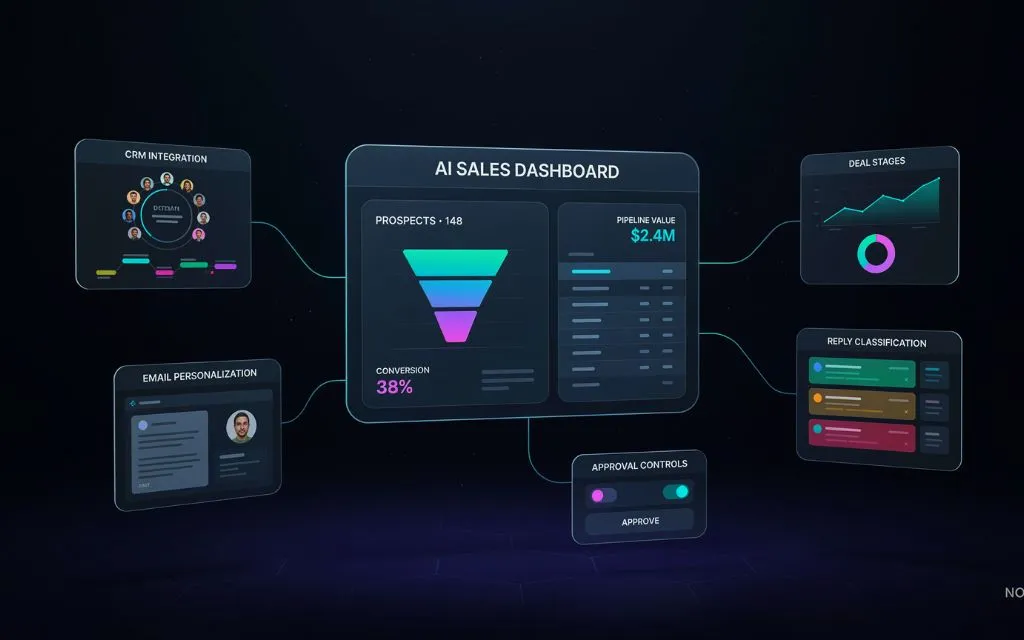
Buying an AI SDR tool based on a flashy feature list can lead to disappointing results.
These are the areas that deserve the most attention.
1. Data Quality
Ask where contact and company information comes from.
Also check how frequently records are updated and how incorrect information is handled.
2. Personalization
Does the system simply insert names and company information, or can it create genuinely relevant messaging from useful context?
That distinction can have a major effect on response quality.
3. CRM Integration
The AI SDR should fit into the systems your sales team already uses.
A good integration can reduce duplicate records and keep sales activity organized.
4. Email Controls
Check whether you can control:
- Sending limits
- Campaign schedules
- Mailboxes
- Domains
- Suppression lists
- Unsubscribe handling
- Approval workflows
5. Human Approval
Not every message needs manual approval, but important conversations should have a clear path to human review.
6. Reply Handling
Ask what happens when someone replies with a question, objection, request for more information, or an unusual response.
This is often more important than the initial email generation feature.
7. Analytics
Useful reporting should go beyond the number of emails sent.
Track metrics such as:
| Metric | Why it matters |
| Positive reply rate | Shows message relevance |
| Qualified leads | Shows prospect quality |
| Meetings booked | Measures sales interest |
| Meeting attendance | Shows lead quality |
| Opportunity conversion | Connects outreach to pipeline |
| Revenue generated | Measures business impact |
| Cost per qualified meeting | Helps compare channels |
Benefits of AI SDR Tools
Less Repetitive Work
AI can handle many repetitive sales tasks that previously consumed human hours.
Higher Outreach Capacity
One AI system can potentially handle a larger volume of structured work than a single salesperson.
Consistent Follow-Up
Automated workflows can reduce the chance that an interested prospect is forgotten.
Faster Responses
AI systems can respond quickly when a prospect asks a straightforward question.
Better Use of Sales Time
When administrative tasks are reduced, salespeople can spend more time on conversations that require human judgment.
Support for Small Teams
A small B2B company may be able to handle more outbound activity without immediately adding a large SDR team.
McKinsey’s 2025 B2B research provides a useful real-world example. One materials company used AI to prioritize opportunities, prepare research and scripts, and handle straightforward customer outreach. After implementation, the company reported 40% higher conversion rates and 30% faster lead execution.
That is a case study, not a guarantee for every business, but it shows what can happen when AI is connected to a clearly defined sales workflow.
Where AI SDR Tools Still Have Limits
AI SDR software can handle repetitive work well, but there are several areas where caution is necessary.
Bad Data Creates Bad Outreach
If the information going into the system is wrong, the message can be wrong too.
A perfectly written email sent to the wrong person is still a bad sales email.
AI Can Misread Context
A short response can have several possible meanings.
“Send me something” could mean genuine interest, polite curiosity, or an attempt to end the conversation.
Human judgment can still matter.
Personalization Can Become Fake
There is a difference between relevant personalization and manufactured personalization.
A message that mentions a prospect’s company without saying anything useful about their situation may still feel automated.
High Volume Can Hurt Deliverability
More emails do not automatically mean more sales.
Poor sending practices can damage sender reputation and reduce inbox placement.
AI Does Not Create a Sales Strategy
An AI SDR needs direction.
Someone still has to decide:
- Who should be contacted?
- What problem are you solving?
- What makes the offer useful?
- Which prospects should be excluded?
- What counts as a qualified lead?
- When should a human take over?
Without good answers to those questions, automation can simply make a weak process run faster.
AI SDRs and Cold Email Compliance
This part deserves more attention than it usually gets.
Automating sales outreach does not remove legal responsibilities.
Rules vary by country and by the type of recipient.
For example, the UK’s Information Commissioner’s Office states that PECR rules apply to electronic direct marketing. Corporate subscribers can generally receive unsolicited B2B electronic marketing without consent under PECR, but the sender must not disguise its identity and must provide a valid address for opting out. Sole traders and certain partnerships receive stronger protections and may require consent or a valid soft opt-in.
The ICO also states that publicly available contact information does not automatically mean the person has consented to marketing.
For businesses using AI SDR software, the practical checklist is straightforward:
- Know which rules apply to your recipients.
- Do not hide who is sending the message.
- Provide a valid way to opt out where required.
- Maintain suppression or do-not-contact records.
- Be careful with personal data.
- Check the rules in every market where you operate.
An AI tool can automate the sending process, but the business using it remains responsible for how that process is configured.
How Much Do AI SDR Tools Cost?
There is no standard price for AI SDR software.
Costs vary based on the level of automation, contact data, number of users, message volume, integrations, and whether the provider charges by usage or subscription.
A basic tool may cost considerably less than an enterprise platform with autonomous agents and managed services.
Instead of comparing only monthly subscription prices, calculate the cost per qualified meeting.
For example:
| Cost | Monthly amount |
| AI SDR software | $500 |
| Contact data | $300 |
| Email infrastructure | $150 |
| Other sales software | $250 |
| Total | $1,200 |
If that system produces 20 genuinely qualified meetings in a month, the basic software cost is not the only number that matters.
You would also want to know how many of those meetings become opportunities and how much revenue they generate.
The real question is not “How cheap is the AI SDR?” It is “Does the sales output justify the total cost?”
Who Should Use AI SDR Tools?
AI SDR software tends to make the most sense when a company has a repeatable outbound sales process.
Startups
Small teams can use AI to handle repetitive prospecting work while founders and sales staff focus on qualified conversations.
B2B SaaS Companies
Software companies often have clearly defined customer profiles, making them a natural fit for structured sales automation.
Agencies
Agencies can use AI to support outbound campaigns for their own services, provided the messaging remains relevant and compliant.
Growing Sales Teams
A larger sales team can use AI to reduce administrative work and give SDRs more time for conversations.
Companies With Large Prospect Pools
If a business has thousands of potential accounts but limited sales capacity, automation can make account research and initial outreach more manageable.
AI SDRs are less useful when every sale depends on highly customized relationship building or long negotiations from the first interaction.
How to Choose the Right AI SDR Tool
Start with the problem, not the software.
Step 1: Identify the Bottleneck
Is your team spending too much time researching prospects?
Are follow-ups being missed?
Are salespeople spending hours writing emails?
Or are qualified leads simply not getting enough attention?
The answer should determine the type of AI tool you need.
Step 2: Decide How Much Autonomy You Want
There are roughly three levels:
| Level | AI role |
| Assistant | Helps a salesperson complete individual tasks |
| Automated workflow | Runs predefined sales sequences |
| Autonomous SDR | Manages several stages of prospect engagement |
More autonomy can mean more efficiency, but it also requires stronger controls.
Step 3: Check Data Sources
Ask where the tool gets its prospect information and how accurate that information is.
Step 4: Test the Messaging
Before sending thousands of emails, test the system with a small sample.
Read the messages yourself.
Would you respond to them?
Do they sound like a real person?
Are they relevant to the recipient?
Step 5: Check Reply Handling
Send different types of test responses and see how the system reacts.
A good AI SDR should have a clear process for escalating complicated conversations to humans.
Step 6: Measure Business Results
Do not judge the tool by activity alone.
Compare:
Cost → Qualified replies → Meetings → Opportunities → Revenue
That chain tells you whether the software is producing a meaningful business result.
Are AI SDR Tools Worth It in 2026?

For many B2B teams, yes, but only when the underlying sales process is already clear.
AI SDR software is particularly useful for repetitive tasks such as research, qualification, outreach, and follow-up.
The strongest evidence so far points toward AI as a way to increase seller capacity rather than simply remove people.
McKinsey’s 2025 research found that 19% of surveyed B2B decision-makers were already implementing generative AI use cases in buying and selling, while another 23% were in the process of doing so.
Real company examples also show how AI SDR systems are being used.
Salesforce reports that Xero introduced an AI agent that acts as an SDR, nurturing leads through personalized emails, answering questions, and booking meetings with human SDRs when appropriate.
Another Salesforce case study involving Asymbl reports that its AI agent handled more than 1,000 leads per week, alongside a human sales team. The company reported $1.5 million in cost savings and 56x business growth, although these figures are company-reported results and should not be treated as a typical outcome for every business.
These examples point to a practical model:
AI handles volume and routine work. Humans handle judgment and valuable conversations.
That is a much more realistic use of AI SDR technology than expecting software to run an entire sales organization by itself.
Final Thoughts
AI SDR tools are changing how businesses approach sales development.
They can research prospects, create outreach, manage follow-ups, classify replies, qualify leads, and schedule meetings. For a team spending too many hours on repetitive sales work, that can make a real difference.
But buying an AI SDR tool does not automatically create a better sales process.
Good targeting still matters. Good data still matters. Good messaging still matters. And human judgment still matters.
The best setup is often a partnership between people and software.
Let AI handle the repetitive tasks that follow clear rules. Give salespeople the conversations that require empathy, context, negotiation, and judgment.
That approach gives businesses a better reason to use AI SDR tools than simply trying to send more emails.
The goal should be better sales conversations, not just more automated activity.
Frequently Asked Questions
What are AI SDR tools?
AI SDR tools are software platforms that automate or assist with sales development tasks such as prospect research, outreach, follow-ups, lead qualification, reply handling, and meeting scheduling.
Can AI SDR tools replace human SDRs?
Not completely. AI can handle many repetitive tasks, but human SDRs remain valuable for complex conversations, relationship building, negotiation, and situations that require judgment.
What does an AI SDR do?
Depending on the platform, an AI SDR can research prospects, create personalized outreach, send follow-ups, classify replies, qualify leads, answer routine questions, and schedule meetings.
Are AI SDR tools worth the money?
They can be worth the investment when they reduce meaningful sales workload or generate qualified opportunities. The best measurement is business output, such as qualified meetings, opportunities, and revenue, rather than email volume alone.
Are AI SDR tools suitable for startups?
Yes. Startups with small sales teams can use AI to handle repetitive prospecting and follow-up work while founders or sales staff focus on important customer conversations.
What is the difference between an AI SDR and an AI sales assistant?
An AI sales assistant usually supports a human salesperson with individual tasks. An AI SDR can manage several connected sales-development activities and may operate with greater autonomy.
Can AI SDR tools send cold emails?
Some can. However, businesses must comply with applicable marketing, privacy, and electronic communication rules. Requirements differ depending on the recipient, country, and type of communication.
What is the most important AI SDR feature?
There is no single feature that matters for every business. Accurate prospect data, useful personalization, strong reply handling, CRM integration, deliverability controls, and human oversight are among the most important areas to evaluate.
Will AI SDRs replace sales teams?
A more realistic expectation is that AI will change how sales teams spend their time. Routine research, administration, outreach, and qualification can increasingly be handled by software, while people focus on customer relationships, complex decisions, and closing opportunities.