


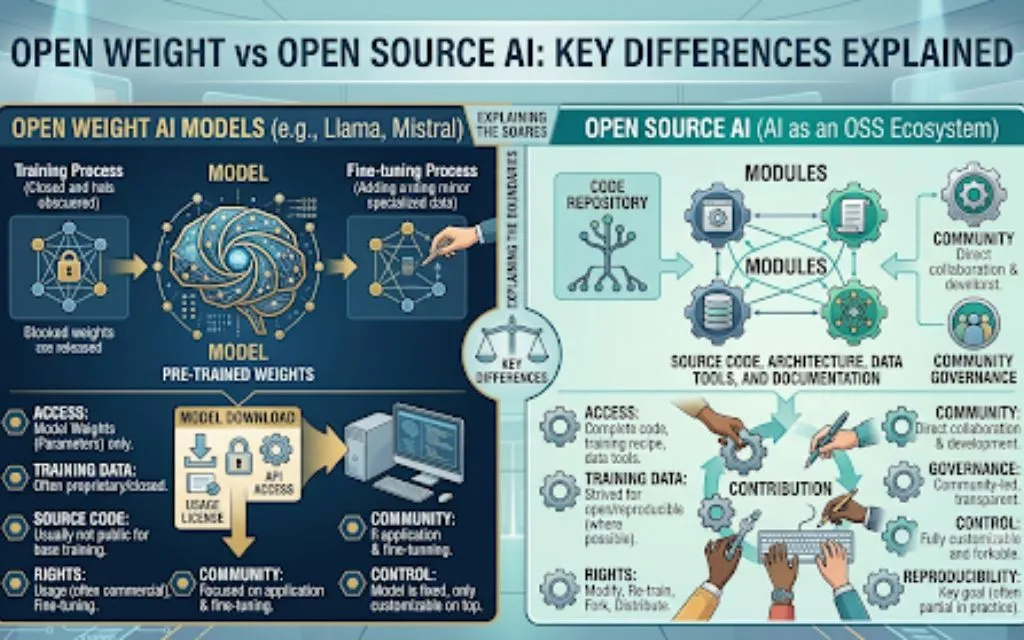

The difference between open weight vs open source AI has become increasingly important as downloadable AI models become more capable. The two terms are often used interchangeably, but they do not describe exactly the same thing.
- Open Weight vs Open Source AI: Quick Answer
- What Is Open-Weight AI?
- What Is Open-Source AI?
- Open Weight vs Open Source AI: The Biggest Difference
- Why Model Weights Matter
- Why Training Data and Training Code Matter
- Open Weight vs Open Source AI for Developers
- Open Weight vs Open Source AI for Businesses
- Open Weight vs Open Source AI: Licensing Matters
- Real Examples of Open-Weight and Open-Source AI
- Open Weight vs Open Source vs Proprietary AI
- Is Open-Weight AI Better Than Open-Source AI?
- How to Check if an AI Model Is Really Open Source
- Why Reproducibility Matters
- Open Weight vs Open Source AI for Privacy
- Open Weight vs Open Source AI and Vendor Lock-In
- Open Weight vs Open Source AI: Final Verdict
- Key Takeaways
- Frequently Asked Questions
- Conclusion
An open-weight AI model generally makes its trained parameters available for download. Depending on its license, developers may be able to run the model locally, fine-tune it, modify it, or use it in commercial applications.
Open-source AI has a broader meaning. The Open Source Initiative’s Open Source AI Definition 1.0 requires freedoms to use, study, modify, and share an AI system, together with access to the preferred form needed to make meaningful modifications. For machine-learning systems, this includes relevant data information, code, and model parameters.
Open Weight vs Open Source AI: Quick Answer
Open-weight AI means the trained model weights are available. Open-source AI goes further by providing the freedoms and materials needed to study, modify, and share the system.
| Feature | Open-Weight AI | Open-Source AI |
| Model weights | Usually available | Available |
| Local deployment | Usually possible | Possible |
| Fine-tuning | Often possible | Yes |
| Training code | May be unavailable | Required as part of the preferred modification form |
| Training-data information | May be limited | Required under OSAID |
| Model architecture | May be documented | Available as part of the relevant system |
| Reproducibility | Often limited | Much stronger |
| Commercial use | License dependent | Must preserve the required freedoms |
| Modification | License dependent | Core freedom |
| Redistribution | License dependent | Core freedom |
| Transparency | Partial to extensive | Broader by definition |
The important point is that downloadable weights alone do not automatically make an AI model open source.
What Is Open-Weight AI?
An open-weight AI model is a model whose learned parameters are made available to outside users.
Model weights are numerical parameters learned during training. They are a major part of what allows a neural network to transform an input into an output. When developers receive the weights, they can potentially run inference without sending every request to the original model provider.
This can make local AI deployment possible.
For example, a developer may download a model, place it on a compatible server, connect it to an application, and run inference locally. Depending on the license and hardware requirements, the model may also be fine-tuned or quantized.
Open weights therefore provide significant practical control.
However, weights are only one part of an AI system.
An open-weight release may not provide the complete training dataset, data-processing pipeline, training code, evaluation code, hyperparameters, intermediate checkpoints, or other information required to reproduce the original model.
The Open Source Initiative describes weights as learned parameters that overlay the model architecture and produce outputs from inputs. It also explains that weights alone do not provide everything needed for the broader Open Source AI standard.
This creates the central distinction:
Open weight describes what has been made available. Open source describes a broader set of freedoms and materials.
What Is Open-Source AI?

Open-source AI applies open-source principles to artificial intelligence systems.
According to the Open Source Initiative, an Open Source AI system should give users four fundamental freedoms:
- Use the system for any purpose
- Study how the system works
- Modify the system
- Share the system with or without modifications
The OSI definition also addresses the preferred form required to modify machine-learning systems.
That preferred form includes three major groups:
Data information: Sufficiently detailed information about the data used to train the system, including provenance, scope, characteristics, selection, labeling, and processing or filtering methods.
Code: The complete source code used to prepare data, train, validate, test, and run the system, including relevant supporting components.
Parameters: Model parameters such as weights and other configuration information.
This makes the definition substantially broader than simply putting a model checkpoint online.
The purpose is meaningful access.
If researchers can download a model but cannot understand how its training data was processed or how its training procedure worked, their ability to reproduce or deeply study the system is limited.
Open Weight vs Open Source AI: The Biggest Difference
The easiest way to understand the difference is to separate the finished model from the process used to create it.
An open-weight release can provide the finished trained model.
A more complete open-source AI release provides the model together with the relevant information and freedoms required to study and modify it.
A useful analogy is a cake.
An open-weight release is similar to receiving the finished cake. The cake can be eaten, examined, or potentially modified according to the applicable permissions.
A genuinely open AI system is closer to receiving the cake, recipe, preparation instructions, ingredient information, and permission to make and share modified versions.
The analogy is not technically perfect, but it explains why model weights alone are not the entire story.
The OSI definition specifically requires data information, code, and parameters in the preferred form for meaningful modification.
Why Model Weights Matter
Model weights are central to modern machine learning.
During training, the model adjusts enormous numbers of parameters based on the examples it processes. Those learned parameters become the trained model’s weights.
Once trained, the weights can be used during inference.
This is why releasing weights can be extremely valuable.
Developers can potentially:
- Run models locally
- Build private AI applications
- Fine-tune models
- Quantize models
- Integrate models into software
- Reduce dependence on hosted APIs
- Experiment with model behavior
- Deploy models in controlled environments
However, the ability to perform each activity depends on the specific license.
A downloadable file does not automatically grant unlimited legal permission.
That is why weights and licensing should always be evaluated separately.
Why Training Data and Training Code Matter
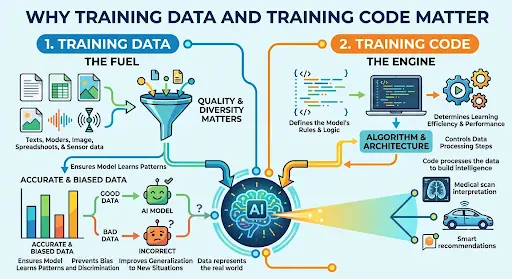
Training data is one of the biggest differences between open-weight and open-source AI.
A trained model contains learned information, but the final weights do not necessarily reveal the complete process that produced them.
Without sufficient information about the training data, researchers may have difficulty understanding:
- Where the data came from
- What types of data were included
- How data was filtered
- How duplicates were handled
- How data was labeled
- What data was excluded
- How the dataset was processed
Training code is equally important.
It can show how the data was transformed, how the model was trained, which configurations were used, and how validation and testing were performed.
The OSI definition therefore treats data information and training code as important parts of the preferred form for modifying machine-learning systems.
This is one reason why reproducibility is a major open-source AI issue.
Open Weight vs Open Source AI for Developers
Developers often care about practical control more than terminology.
An open-weight model can be highly useful for developers because it may allow local inference and customization.
A developer can potentially deploy the model on private infrastructure rather than sending sensitive prompts and documents to a third-party API.
Open-weight models can also be useful for custom chatbots, coding assistants, document processing, retrieval-augmented generation, private knowledge bases, research systems, offline applications, edge AI, and specialized fine-tuning. If you’re building your own AI-powered system from scratch, it also helps to understand how to create an AI agent so you can decide whether an open-weight model fits your architecture.
Open Weight vs Open Source AI for Businesses
Businesses have additional concerns.
A company evaluating an AI model should consider more than whether the weights can be downloaded.
Important questions include:
Can the model be used commercially?
Commercial use depends on the license.
Can the model be modified?
Some licenses permit modification while adding additional conditions.
Can the model be redistributed?
This matters when the AI model becomes part of a commercial product.
Can customer data remain private?
Local deployment can provide greater infrastructure control, although privacy still depends on how the deployment is designed.
What happens if the provider changes its terms?
A self-hosted model can reduce some forms of API dependency.
What are the infrastructure costs?
Self-hosting removes or reduces API fees but can introduce GPU, storage, networking, maintenance, monitoring, and engineering costs.
Open-weight AI can therefore provide significant control without automatically being the cheapest option.
Recent industry analysis has highlighted the growing appeal of open-weight models because of cost, customization, and control, while also noting that self-hosting introduces its own infrastructure requirements and risks.
Open Weight vs Open Source AI: Licensing Matters
Licensing is one of the most important parts of this topic.
Two models can both be downloadable while providing different legal rights.
For example, DeepSeek-R1’s official repository states that its code repository and model weights are licensed under the MIT License. It explicitly permits commercial use, modifications, derivative works, and distillation.
Llama 3.1 is different.
Meta’s official Llama 3.1 model card identifies its license as the Llama 3.1 Community License, rather than a standard MIT or Apache 2.0 license. The license includes additional requirements, including attribution and specific commercial conditions.
This demonstrates why the phrase “open model” is not enough.
The actual license must be checked.
Real Examples of Open-Weight and Open-Source AI
DeepSeek-R1
DeepSeek-R1 is an important example because its official repository makes the code and model weights available under MIT licensing and explicitly permits commercial use, modifications, derivative works, and distillation.
However, the OSI definition evaluates the broader AI system, not simply whether weights have been released under a permissive license.
Therefore, it is useful to distinguish between permissively licensed open weights and the stricter OSI meaning of open-source AI.
Llama 3.1
Meta’s Llama 3.1 release provides downloadable model weights and supporting materials, but its official license is a custom Llama Community License.
The license contains additional requirements, including redistribution notices, “Built with Llama” attribution, naming requirements for certain derivative AI models, an acceptable use policy, and a special commercial provision related to products with more than 700 million monthly active users.
That makes Llama a useful example of why downloadable weights and unrestricted open-source software are not identical concepts.
Pythia
Pythia is an especially useful research example.
EleutherAI states that its Pythia project publicly releases the models, data, and code used in its research. It also provides 154 checkpoints for each model, allowing researchers to examine learning dynamics throughout training.
The Pythia models were trained on the same data in the same order, and the project provides information needed to reproduce the training setup. The models processed approximately 299.9 billion tokens during training.
This level of disclosure is much closer to the reproducibility goals associated with open-source AI.
OLMo
OLMo is another important example in discussions around genuinely open AI research.
The Open Source Initiative has identified OLMo among systems that passed its validation phase. Its approach is notable because it focuses on releasing much more than a final checkpoint.
That broader release philosophy makes OLMo useful when comparing open weights with systems designed for reproducible AI research.
Open Weight vs Open Source vs Proprietary AI
The AI landscape can be simplified into three broad categories.
Proprietary AI
Proprietary models generally keep important model components private.
Users commonly access them through hosted applications or APIs.
The provider controls the model weights and much of the underlying infrastructure.
Open-Weight AI
Open-weight systems make trained parameters available.
Users may be able to download, self-host, fine-tune, or modify the model depending on its license.
The training process may remain partially or largely undisclosed.
Open-Source AI
Open-source AI, under the OSI definition, provides the freedoms and preferred modification materials needed to use, study, modify, and share the system.
The distinction can therefore be summarized as:
Proprietary = access to the service
Open weight = access to trained parameters
Open source, broader access, freedoms, and modification materials
Is Open-Weight AI Better Than Open-Source AI?
Neither is automatically better.
The right choice depends on the objective.
Open-weight AI can be the better practical choice when a company primarily needs:
- Local inference
- Fine-tuning
- Private deployment
- Lower API dependency
- Model customization
- Offline operation
Open-source AI can be more valuable when an organization prioritizes:
- Reproducibility
- Training transparency
- Data provenance
- Independent research
- Auditing
- Long-term modification
- Community collaboration
A business that only needs a capable model for internal inference may not require complete training transparency.
A research laboratory investigating model behavior may consider training data and code essential.
How to Check if an AI Model Is Really Open Source
Before adopting an AI model, the following audit can prevent many problems.
Check the model weights
Are the actual trained parameters available?
Check the license
Is the license standard, custom, permissive, or restrictive?
Check commercial rights
Does the license allow the intended business use?
Check modification rights
Can the model be fine-tuned and changed?
Check redistribution
Can the original or modified model legally be redistributed?
Check training code
Is the code used to train the model available?
Check data information
Does the release provide meaningful information about training data and its processing?
Check model architecture
Is enough technical information available to understand the system?
Check the version
A model family can contain multiple releases with different licenses and documentation.
Check additional policies
Usage policies, attribution requirements, naming rules, user thresholds, and other conditions may apply.
This process is more reliable than relying on the word “open” in a model announcement.
Why Reproducibility Matters
Reproducibility is one of the strongest reasons to care about the open-weight vs open-source distinction.
Suppose two research teams download exactly the same weights.
They can study the model and compare outputs.
But if the training data, preprocessing pipeline, training code, and configuration are unavailable, they may not be able to reproduce the original training process.
A more complete release makes it possible to investigate how the model developed.
Pythia provides an especially clear example. EleutherAI released the models, data, code, and numerous intermediate checkpoints so researchers can examine model development over time.
This makes reproducibility more than a theoretical benefit.
It becomes a research tool.
Open Weight vs Open Source AI for Privacy
Privacy is another major reason organizations consider open-weight models.
A locally deployed model can potentially process sensitive information without sending every prompt to a third-party hosted AI provider.
This can be useful for:
- Internal documents
- Customer records
- Confidential business information
- Private source code
- Sensitive research
- Regulated workloads
However, local deployment does not automatically guarantee privacy.
The organization still needs to secure its servers, logs, databases, model endpoints, user access, and network infrastructure.
The important distinction is that self-hosting can give the organization greater control over where inference takes place.
Open Weight vs Open Source AI and Vendor Lock-In
Vendor lock-in occurs when an organization becomes heavily dependent on a particular provider.
Hosted proprietary AI can create dependency on:
- API pricing
- API availability
- Provider policies
- Model version changes
- Rate limits
- Service outages
- Provider-specific features
Open-weight models can reduce some of these dependencies because the model can potentially be hosted independently.
Open-source AI can provide an even broader form of control because the development materials may also be available for inspection and modification.
However, open models do not eliminate all lock-in.
Organizations can still become dependent on specific hardware, inference frameworks, cloud infrastructure, or specialized engineering teams.
Open Weight vs Open Source AI: Final Verdict
The difference can be reduced to one central idea:
Open weight tells users that trained parameters are available. Open-source AI makes a broader claim about freedom, transparency, modification, and the materials needed to understand and change the system.
An open-weight model can be extremely useful without being fully open source.
DeepSeek-R1 demonstrates how permissive licensing can make an open-weight model highly flexible for commercial use and modification. Llama 3.1 demonstrates how downloadable weights can still operate under a custom license with additional requirements. Pythia demonstrates what a much more reproducible research release can look like.
For developers, the most important lesson is simple:
Do not judge an AI model by the word “open” alone.
The actual weights, code, data information, license, redistribution rights, commercial terms, and documentation should all be checked before deployment.
Key Takeaways
- Open-weight AI primarily refers to publicly available trained parameters.
- Open-source AI has a broader technical and legal meaning.
- Downloadable weights do not automatically make a model open source.
- Training data information is an important part of the OSI definition.
- Training and inference code can be essential for meaningful modification.
- Licensing determines what developers can legally do.
- Open-weight models can support local deployment and fine-tuning.
- Open-source AI offers stronger transparency and reproducibility.
- DeepSeek-R1 uses MIT licensing for its code and model weights.
- Llama 3.1 uses a custom community license with additional conditions.
- Pythia provides models, data, code, and extensive training checkpoints.
- The best model depends on the organization’s technical, legal, privacy, and business requirements.
Frequently Asked Questions
Is open weight the same as open source AI?
No. Open weight generally means that trained model parameters are available. Open-source AI requires broader freedoms and access to the preferred materials needed to study and modify the system.
What is the main difference between open-weight and open-source AI?
The main difference is scope. Open-weight focuses on access to trained parameters. Open-source AI also addresses freedoms, code, data information, modification, study, and sharing.
Are open-weight AI models free?
Some are available without a purchase price, but “free to download” does not necessarily mean unrestricted. The applicable license determines permitted use.
Can open-weight models be used commercially?
Some can. DeepSeek-R1’s official repository explicitly states that commercial use is supported under its MIT licensing terms. Other models can have different conditions.
Can open-weight models be fine-tuned?
Many can be fine-tuned, but the model license should be checked first. Technical capability and legal permission are separate questions.
Is Llama open source?
Llama provides downloadable model weights, but its specific releases use Meta’s own license terms. Llama 3.1, for example, uses the Llama 3.1 Community License with additional conditions.
Is DeepSeek-R1 open source?
DeepSeek describes R1 as open source and its repository provides MIT licensing for the code repository and model weights. However, the stricter OSI definition evaluates the broader AI system, including training data information and code, rather than only downloadable weights.
What is an example of a highly reproducible open AI project?
Pythia is a strong example. EleutherAI publicly released the models, data, code, and numerous intermediate checkpoints used by the project.
Why does training data matter for open-source AI?
Training data information helps researchers understand data provenance, selection, processing, filtering, and other factors that influence the resulting model. The OSI definition specifically includes detailed data information in the preferred modification form.
Which is better for businesses, open weight or open source AI?
Neither is universally better. Open weight may be preferable for local deployment and customization, while open-source AI can be more valuable when transparency, reproducibility, and long-term modification are priorities.
How can a business check an AI model’s openness?
The business should inspect the model weights, exact license, training code, data information, commercial-use rights, modification rights, redistribution conditions, and additional policies before deployment.
Does open-source AI mean there are no costs?
No. Open-source AI can remove or reduce some licensing costs, but infrastructure, GPUs, storage, engineering, maintenance, monitoring, security, and support can still cost money.
Does open-weight AI eliminate vendor lock-in?
It can reduce dependence on a model provider, particularly when the model can be self-hosted. It does not eliminate all infrastructure or hardware dependencies.
Conclusion
The open weight vs open source AI debate is ultimately about what “open” actually means.
Open-weight AI gives developers access to trained parameters and can provide powerful benefits such as local deployment, customization, fine-tuning, and greater infrastructure control.
Open-source AI goes further by addressing the freedoms and materials needed to study, modify, reproduce, and share an AI system.
The Open Source Initiative’s definition provides the clearest formal benchmark. It covers four core freedoms and identifies data information, code, and parameters as important parts of the preferred form for modifying machine-learning systems.
For that reason, the most reliable way to evaluate an AI model is not to ask only whether it is called “open.”
The better question is:
What exactly has been released, under what license, and what can actually be done with it?
That question gives developers, researchers, and businesses a much clearer picture of the model’s real level of openness.