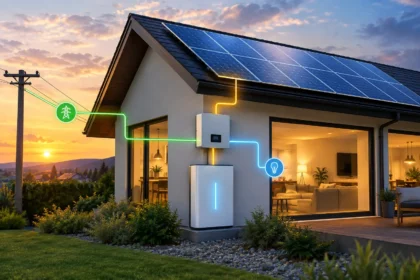




Home solar battery storage saves electricity produced by solar panels so you can use it later, such as at night or during a power outage.
- What Is Home Solar Battery Storage?
- How Does Solar Battery Storage Work?
- Why Add a Battery to a Home Solar System?
- Types of Solar Batteries
- How Much Solar Battery Storage Do You Need?
- Solar Battery Capacity vs Power
- How Long Can a Solar Battery Power a Home?
- Solar Battery Backup During Power Outages
- How to Choose a Home Solar Battery
- Solar Battery Cost
- Solar Battery Maintenance and Safety
- DC-Coupled vs AC-Coupled Solar Battery Systems
- How to Get the Right Battery Size
- Pros and Cons of Home Solar Battery Storage
- Is Home Solar Battery Storage Worth It?
- Key Takeaway
- FAQs
- Conclusion
The right battery depends on your daily electricity use, backup needs, solar system size, battery capacity, power output, usable capacity, and local electricity rates. A battery stores energy in kilowatt-hours (kWh), while its power output is measured in kilowatts (kW).
What Is Home Solar Battery Storage?
Home solar battery storage is a system that stores electricity generated by solar panels for later use.
Solar panels produce electricity when sunlight reaches their photovoltaic cells. However, solar production changes throughout the day. Production usually falls after sunset, while many households continue using electricity in the evening. A battery helps move some of the daytime solar energy to a later time.
For example, imagine your solar panels produce more electricity than your home needs at 1 p.m.
Instead of sending all of that extra electricity to the grid, a battery system can store some of it.
Later, at 8 p.m., when the panels are no longer producing solar power, the battery can supply electricity to the home.
Simple Example
The basic process looks like this:
Sunlight → Solar Panels → Inverter → Home + Battery
Later:
Battery → Inverter → Home Appliances
During an outage, a properly configured solar-plus-storage system can also provide backup power to selected circuits or, depending on the system design, a larger portion of the home.
How Does Solar Battery Storage Work?
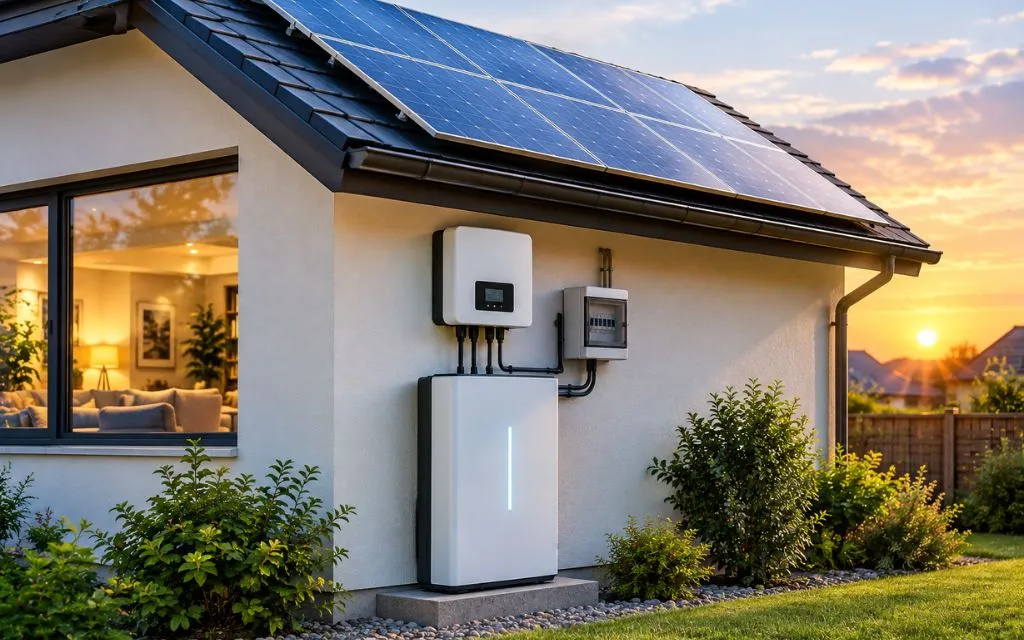
A home solar battery system usually works through several main components.
1. Solar Panels Generate Electricity
Solar panels convert sunlight into direct-current electricity.
The photovoltaic cells inside the panels absorb sunlight and create an electrical current.
2. The Inverter Converts Electricity
Most household appliances use alternating-current electricity.
An inverter converts the DC electricity from the solar panels into AC electricity that the home can use. Depending on the system design, battery charging and discharging also involve power electronics and battery management equipment.
3. Extra Solar Power Charges the Battery
When solar production is higher than the home’s immediate demand, the system can send available electricity to the battery.
The battery stores that energy chemically.
4. The Battery Discharges Later
When solar production falls or household demand increases, the battery can send stored energy back through the system.
That electricity can then power household loads.
5. The Grid Can Work Alongside the System
A grid-connected home may use solar, battery power, and grid electricity at different times.
The exact operating strategy depends on the inverter, battery controls, utility rules, electricity rates, and system configuration.
Why Add a Battery to a Home Solar System?
Solar panels and batteries solve different problems.
Solar panels generate electricity.
Batteries store electricity.
Combining them can make solar energy more useful throughout the day.
Use Solar Power at Night
Without storage, solar production generally drops after sunset.
A battery can store some daytime solar energy and make it available later.
This is one of the main reasons homeowners add storage.
Reduce Reliance on Grid Electricity
If your battery charges from your solar panels and later supplies household loads, you may need less grid electricity during certain periods.
The financial impact depends on your electricity rates, solar production, battery efficiency, utility rules, and how the system is operated.
Backup During Power Outages
A properly designed solar-plus-storage system can keep selected home loads operating during a grid outage.
This can be useful for:
- Refrigerators
- Lights
- Internet equipment
- Security systems
- Fans
- Medical equipment where appropriate
- Essential outlets
However, solar panels alone usually do not provide backup during a grid outage. A grid-connected PV system normally shuts down when grid power fails unless it has the appropriate inverter and storage configuration.
Better Use of Excess Solar Energy
During sunny periods, your panels may produce more electricity than your home needs.
Battery storage provides another way to use that energy later instead of relying only on immediate consumption or grid export.
Types of Solar Batteries
Several battery chemistries can be used for energy storage.
Lithium-Ion Batteries
Lithium-ion batteries are widely used in modern energy storage systems.
They offer a combination of energy density, efficiency, and established supply chains.
Many residential battery systems use lithium-based chemistry.
Lithium Iron Phosphate Batteries
Lithium iron phosphate, commonly called LFP or LiFePO4, is a lithium battery chemistry used in many modern energy-storage products.
Its characteristics can make it suitable for stationary storage applications.
When comparing an LFP battery, check the manufacturer’s specifications for usable capacity, cycle information, warranty, temperature limits, and installation requirements.
Lead-Acid Batteries
Lead-acid batteries have a long history in solar applications.
They can still be used in certain systems, especially where upfront cost or specific system requirements matter.
However, they generally have different depth-of-discharge, maintenance, weight, and lifespan characteristics compared with modern lithium-based batteries.
The U.S. Department of Energy notes that lithium-ion, lead-acid, sodium, and nickel-based batteries are among the electrochemical storage technologies used for energy storage.
Also Read: Beyond Bug Control: How Mira Home Pest Control
How Much Solar Battery Storage Do You Need?
Battery sizing depends on what you want the battery to accomplish.
There is no single battery size that works for every home.
A homeowner who only wants to use solar power after sunset may need a different system from someone who wants overnight backup during a power outage.
Step 1: Check Daily Electricity Use
Start by checking your electricity bills or monitoring data.
Look for your average daily energy consumption.
For example, suppose a home uses:
20 kWh per day
That does not automatically mean you need a 20 kWh battery.
The battery may only need to cover evening usage or selected backup loads.
Step 2: Decide What You Want to Power
Make a list of important appliances.
| Appliance | Example Power Use | Priority |
| LED lights | Low | High |
| Wi-Fi router | Low | High |
| Refrigerator | Moderate | High |
| TV | Moderate | Medium |
| Fans | Moderate | High |
| Washing machine | Moderate | Medium |
| Air conditioner | High | Depends on system |
| Electric water heater | High | Depends on system |
| Electric oven | High | Usually lower priority |
Actual consumption varies significantly by appliance, model, usage pattern, and operating conditions.
Step 3: Calculate Your Backup Requirement
If your priority is backup, calculate the energy needed by your essential appliances during the expected outage period.
For example:
If essential appliances use approximately 2 kWh per hour, and you want four hours of backup:
2 kWh × 4 hours = 8 kWh
You would then need to account for usable battery capacity, inverter losses, reserve settings, and other system losses.
This is why a battery’s advertised capacity should not be treated as the exact amount of electricity your home can use.
Solar Battery Capacity vs Power
These two specifications are easy to confuse.
Energy Capacity
Battery capacity tells you how much energy the battery can store.
It is normally measured in:
kilowatt-hours (kWh)
A battery with 10 kWh of usable capacity can theoretically supply 10 kWh of energy before reaching its operating limit.
Power Output
Power tells you how much electricity the battery can deliver at one time.
It is measured in:
kilowatts (kW)
A battery could have plenty of stored energy but still struggle to run a high-power appliance if its inverter or output rating is too low.
The U.S. Department of Energy specifically distinguishes energy capacity, measured in kWh, from power capacity, measured in kW.
Simple Example
Imagine a battery with:
- 10 kWh usable capacity
- 5 kW continuous power output
It may have enough stored energy for several hours of moderate loads, but it may not be able to supply a very large load that exceeds its output capability.
So, always check both kWh and kW.
How Long Can a Solar Battery Power a Home?
Battery runtime depends on several factors.
The basic calculation is:
Runtime = Usable Battery Capacity ÷ Average Load
For example:
10 kWh ÷ 2 kW = 5 hours
This is a simplified calculation.
Real-world runtime can be lower because of:
- Inverter losses
- Battery reserve settings
- Appliance startup loads
- Temperature
- Battery operating limits
- Changes in household demand
If the home uses only 1 kW on average, the same battery could potentially last longer.
If the home uses 4 kW, it would run down much faster.
Why Appliance Choice Matters
A refrigerator, lights, router, and fans may consume much less power than an air conditioner, electric heater, or electric oven.
During an outage, managing high-energy appliances can significantly extend battery runtime.
Solar Battery Backup During Power Outages
Backup power is one of the most common reasons homeowners consider battery storage.
But not every solar battery installation provides the same level of backup.
Essential Loads Backup
One approach is to connect selected circuits to a backup panel.
These circuits might power:
- Lights
- Refrigerator
- Internet
- Security equipment
- Selected outlets
This can reduce battery size requirements.
Whole-Home Backup
A larger system may be designed to support more of the home.
However, whole-home backup can require:
- Higher battery capacity
- Higher inverter output
- Appropriate electrical equipment
- Correct load management
- Professional installation
Large appliances such as air conditioners and electric water heaters can have substantial power requirements.
Can Solar Panels Charge the Battery During an Outage?
Depending on the system design, yes.
Some solar-plus-storage systems can continue using solar generation during an outage while operating in an electrically isolated mode.
The exact capability depends on the inverter, battery, controls, and installation configuration.
How to Choose a Home Solar Battery
Do not choose a battery based only on its capacity.
Check the following specifications.
1. Usable Capacity
Look for the usable battery capacity rather than only the total or nominal capacity.
Usable capacity tells you how much energy the system is designed to make available under its operating limits.
2. Continuous Power Output
Check how much power the battery and inverter can provide continuously.
This matters when running multiple appliances at the same time.
3. Surge Power
Some appliances need extra power when starting.
Motors and compressors, for example, may have higher startup demand than their normal operating power.
Check the system’s surge rating if you plan to operate such equipment during an outage.
4. Round-Trip Efficiency
Energy storage is not perfectly efficient.
Some energy is lost during charging and discharging. DOE notes that storage systems are not 100% efficient because energy is lost during conversion and retrieval.
A higher round-trip efficiency generally means less energy is lost through the storage process.
5. Battery Chemistry
Compare the chemistry, expected lifespan, operating temperature range, maintenance requirements, and warranty.
6. Warranty
Review:
- Warranty years
- Cycle limits
- Capacity retention
- Throughput limits
- Labor coverage
- Replacement terms
Do not assume every battery warranty works the same way.
7. Inverter Compatibility
The battery must work with the inverter and other electrical equipment in the solar system.
If you already have solar panels, ask whether the battery can be added to your existing setup or whether additional equipment is required.
8. Installation Requirements
Battery installation may involve electrical, fire, building, and utility requirements.
DOE recommends reviewing local codes and requirements when planning residential battery storage.
Solar Battery Cost
The cost of a home solar battery depends on many variables.
These can include:
- Battery capacity
- Battery chemistry
- Inverter equipment
- Installation
- Electrical upgrades
- Backup panel
- Monitoring equipment
- Local labor
- Permits
- Warranty
- System configuration
Because these factors vary widely by location and system design, there is no single price that applies to every home.
What Should Be Included in a Quote?
Ask the installer to separate the costs for:
| Cost Item | What to Check |
| Battery | Model and usable capacity |
| Inverter | Power rating and compatibility |
| Installation | Labor and electrical work |
| Backup equipment | Transfer or backup panel |
| Permits | Local approval costs |
| Monitoring | App and system monitoring |
| Warranty | Years and coverage |
| Additional work | Wiring, upgrades, structural work |
Getting multiple detailed quotes makes it easier to compare systems.
Solar Battery Maintenance and Safety
Modern residential battery systems are designed with safety controls, but correct installation and operation still matter.
Use a Qualified Installer
Battery systems involve high electrical energy.
Installation should follow applicable electrical, building, fire, and manufacturer requirements.
Keep the Battery in the Approved Location
Follow the manufacturer’s installation requirements for:
- Temperature
- Ventilation
- Clearances
- Moisture
- Indoor or outdoor placement
Monitor the System
Many modern systems provide monitoring through an app or control system.
Regular monitoring can help identify unusual performance or system alerts.
Do Not Modify the Battery Yourself
Avoid opening, rewiring, or modifying a battery system unless you are a qualified professional working according to the manufacturer’s instructions.
Watch for Warning Signs
Contact the installer or manufacturer if you notice:
- Unusual heat
- Physical damage
- Swelling
- Smoke
- Burning smells
- Repeated fault messages
- Water intrusion
For serious electrical or battery safety concerns, follow the manufacturer’s emergency instructions and local emergency guidance.
DC-Coupled vs AC-Coupled Solar Battery Systems
Battery storage can be connected to solar systems in different ways.
DC-Coupled System
In a DC-coupled configuration, solar panels and the battery share a DC side of the system before electricity is converted to AC.
This arrangement can reduce some conversion steps.
AC-Coupled System
An AC-coupled system uses power conversion equipment that connects the solar and battery systems on the AC side.
This can be useful when adding a battery to an existing solar installation.
The best configuration depends on the solar system, inverter design, battery equipment, cost, and installation requirements. DOE describes both AC- and DC-coupled configurations for solar-plus-storage systems.
How to Get the Right Battery Size
A simple sizing process can help you avoid buying too little or too much storage.
Step 1: Review Your Electricity Bills
Find your average daily consumption.
Step 2: Identify Nighttime Usage
Estimate how much electricity you use after sunset.
Step 3: List Critical Backup Loads
Decide which appliances must continue working during an outage.
Step 4: Check Solar Production
Your battery should work with the amount of solar energy your system can actually produce.
Solar output depends on factors such as system size, sunlight, roof orientation, shading, weather, and other site conditions.
Step 5: Compare Battery Specifications
Check:
- Usable kWh
- Continuous kW
- Surge output
- Efficiency
- Warranty
- Chemistry
- Operating temperature
- Backup capability
Step 6: Get a Professional System Design
A qualified installer can assess the electrical system, solar array, battery, inverter, loads, and local requirements.
Pros and Cons of Home Solar Battery Storage
Pros
- Stores excess solar energy
- Allows solar power to be used after sunset
- Can provide backup power
- Can reduce grid electricity use at certain times
- Can improve energy resilience
- Can reduce some solar energy waste
- Works with grid-connected solar systems
Cons
- Adds upfront cost
- Batteries have a limited service life
- Storage loses some energy during charging and discharging
- Large loads require higher power ratings
- Installation may require electrical upgrades
- Local rules and utility requirements vary
- A battery does not automatically provide whole-home backup
Is Home Solar Battery Storage Worth It?
The answer depends on your goals and local electricity system.
Battery storage may be especially useful if you:
- Have frequent power outages
- Want backup electricity
- Use a lot of electricity after sunset
- Have limited value for exporting excess solar
- Want greater energy independence
- Have electricity rates that vary by time
On the other hand, a battery may not be financially attractive for every household.
The decision should consider the battery’s installed cost, expected life, warranty, electricity rates, solar production, backup needs, and available incentives.
DOE notes that there is no universal solar solution for every homeowner, so system design should be based on the property’s conditions and the homeowner’s goals.
Key Takeaway
Home solar battery storage allows you to save solar electricity and use it later.
A battery can help supply electricity after sunset and may provide backup power during grid outages when the system is designed for that purpose.
When choosing a battery, focus on more than the headline capacity. Check usable kWh, continuous kW, surge output, efficiency, chemistry, warranty, inverter compatibility, and backup capability.
The right system is the one that matches your actual electricity use, solar production, and backup requirements.
FAQs
1. What is home solar battery storage?
Home solar battery storage is a system that stores electricity generated by solar panels so it can be used later, including at night or during a power outage.
2. How does a solar battery work?
Solar panels generate electricity during sunlight hours. Excess electricity can charge the battery, which can later discharge stored energy to power household loads.
3. How many solar batteries do I need for my home?
It depends on your electricity use, desired backup duration, solar production, battery capacity, and the appliances you want to run.
4. How long does a solar battery last?
Battery lifespan varies by chemistry, usage, temperature, cycling, and manufacturer specifications. Check the warranty and expected capacity retention for the specific model.
5. Can a solar battery power a house at night?
Yes. A sufficiently sized battery can provide stored electricity at night. Runtime depends on usable capacity and household power consumption.
6. Can solar batteries work during a power outage?
Yes, if the solar-plus-storage system is designed and installed for backup operation. Solar panels alone generally do not provide power during a grid outage.
7. What size battery is best for a home?
There is no universal size. A common approach is to calculate daily energy use and identify the appliances you want to run during normal operation or an outage.
8. What does kWh mean on a solar battery?
kWh means kilowatt-hours. It describes the amount of energy a battery can store.
9. What does kW mean on a solar battery?
kW describes power. It indicates how much electrical power the battery and inverter can provide at a given time.
10. Can I add a battery to an existing solar system?
Often, yes. However, compatibility depends on the existing inverter, solar configuration, battery technology, electrical equipment, and installation design.
11. Are lithium batteries good for home solar?
Lithium-based batteries are widely used in modern energy storage. The right chemistry depends on the system’s requirements, warranty, operating environment, budget, and manufacturer’s specifications.
12. Do solar batteries need maintenance?
Maintenance requirements vary by battery type and manufacturer. Modern systems may require relatively little routine maintenance, but they should still be monitored and professionally serviced when needed.
Conclusion
A home solar battery storage system can make solar energy more useful by moving electricity from sunny hours to times when your home needs it.
The battery can store excess solar production during the day and supply electricity later. With the right inverter and backup configuration, it can also help keep important household loads running during a power outage.
Before buying, calculate your electricity needs and decide what you actually want the battery to do. Then compare usable capacity, power output, efficiency, battery chemistry, warranty, compatibility, installation requirements, and total installed cost.
A properly sized system can provide a practical combination of solar energy, storage, and backup power without paying for more battery capacity than your home actually needs.