

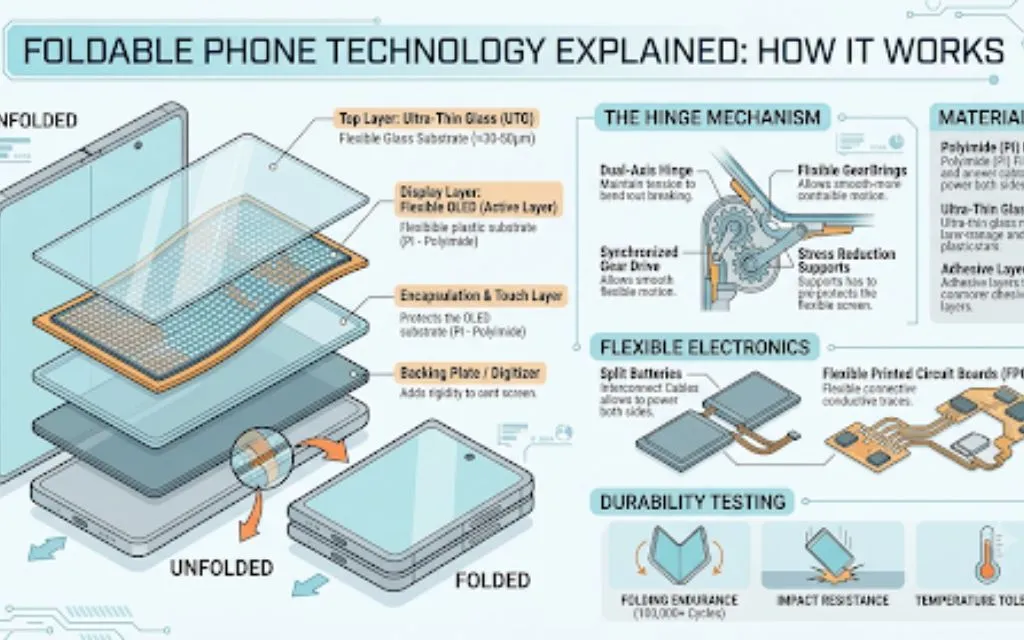

Foldable phone technology explained simply: a foldable smartphone combines a flexible OLED display, ultra-thin protective materials, a specially engineered hinge, flexible internal components, compact batteries, and software that adapts to different screen positions. When closed, the device behaves like a normal smartphone. When opened, the flexible display expands into a much larger screen.
- What Is Foldable Phone Technology?
- How Does a Foldable Phone Work?
- What Is Inside a Foldable Phone Screen?
- What Is Ultra Thin Glass?
- How Does the Hinge Work?
- Why Do Foldable Phones Have a Crease?
- How Do Foldable Phones Handle Batteries and Heat?
- How Does Foldable Phone Software Work?
- What Are the Main Types of Foldable Phones?
- Are Foldable Phones Durable?
- Advantages and Disadvantages of Foldable Phone Technology
- What Is the Future of Foldable Phone Technology?
- Frequently Asked Questions
- How does foldable phone technology work?
- What makes a phone screen foldable?
- Why do foldable phones have a crease?
- Are foldable phone screens made of glass?
- Are foldable phones durable?
- What is a tri-fold phone?
- Are foldable phones worth buying?
- Key Takeaway
Modern foldables are not simply phones with a screen that bends. They are complete hardware and software systems designed around repeated movement. The display, hinge, chassis, battery, cooling system and operating system all have to work together.
What Is Foldable Phone Technology?
Foldable phone technology allows a smartphone to change its physical shape while keeping its display functional. Instead of using a rigid glass panel like a traditional smartphone, a foldable uses a flexible display structure that can bend along a controlled area.
Most modern folding phones use OLED technology because OLED panels can be made thinner and can work with flexible substrates. Unlike LCD screens, OLED pixels produce their own light, so the display does not require a separate backlight. This helps manufacturers build thinner display structures that are better suited to folding.
The result is a device that can offer two different experiences. A clamshell phone can become smaller when folded, while a book-style foldable can open into a tablet-like display.
This is why foldable phones are often described as a combination of smartphone portability and tablet-sized screen space.
How Does a Foldable Phone Work?
A foldable phone works through several layers of technology rather than one special component.
The basic system includes a flexible OLED panel, flexible substrate, thin-film transistor layer, OLED light-emitting layer, protective layers, ultra-thin glass, hinge, supporting structure and flexible circuitry.
Think of the display as a very thin layered structure. Each layer performs a different job. The flexible substrate provides the foundation, the TFT layer controls individual pixels, the OLED layer produces light, and the upper layers protect the display from everyday contact.
Android Authority explains that flexible OLED displays can use materials such as polyimide in the substrate, while modern foldables increasingly use Ultra Thin Glass as part of the protective structure.
When the user folds the phone, the hinge controls how the two halves move. At the same time, the display bends around a carefully engineered radius instead of being forced into an uncontrolled sharp angle.
Why OLED Is Important
OLED is especially useful for foldable devices because the pixels are self-emissive. There is no large backlight assembly behind the panel.
This reduces the number of rigid components that would otherwise make bending difficult.
A foldable OLED still contains several layers, however. Making every layer flexible enough to survive repeated movement is one of the major engineering challenges behind folding phones.
What Is Inside a Foldable Phone Screen?
A foldable display is more complicated than a traditional flat smartphone screen.
Important layers can include:
| Component | Main purpose |
| Flexible substrate | Supports the display structure |
| TFT layer | Controls electrical power to pixels |
| OLED layer | Produces light and colors |
| Encapsulation | Helps protect sensitive display components |
| Ultra Thin Glass | Adds surface protection while remaining flexible |
| Protective film | Provides another protective layer |
| Support structure | Helps manage bending and mechanical stress |
The exact construction varies between manufacturers and models.
Google explains that foldable displays combine materials such as ultra-thin glass and plastics to achieve a balance between flexibility and durability.
What Is Ultra Thin Glass?
Ultra Thin Glass, or UTG, is specially manufactured glass that is thin enough to flex while remaining more glass-like than conventional plastic display covers.
Traditional smartphone glass is designed to remain rigid. UTG has to tolerate repeated bending.
It can provide a different feel and improved scratch resistance compared with softer polymer surfaces, while still allowing the display to fold.
Samsung’s current foldable phones use UTG on the inner folding display and combine it with other protective materials.
However, UTG does not mean the inner screen is as resistant to abuse as a conventional rigid smartphone screen. A folding display remains a complex mechanical structure, and users still need to treat it carefully.
How Does the Hinge Work?
The hinge is one of the most important parts of a foldable smartphone.
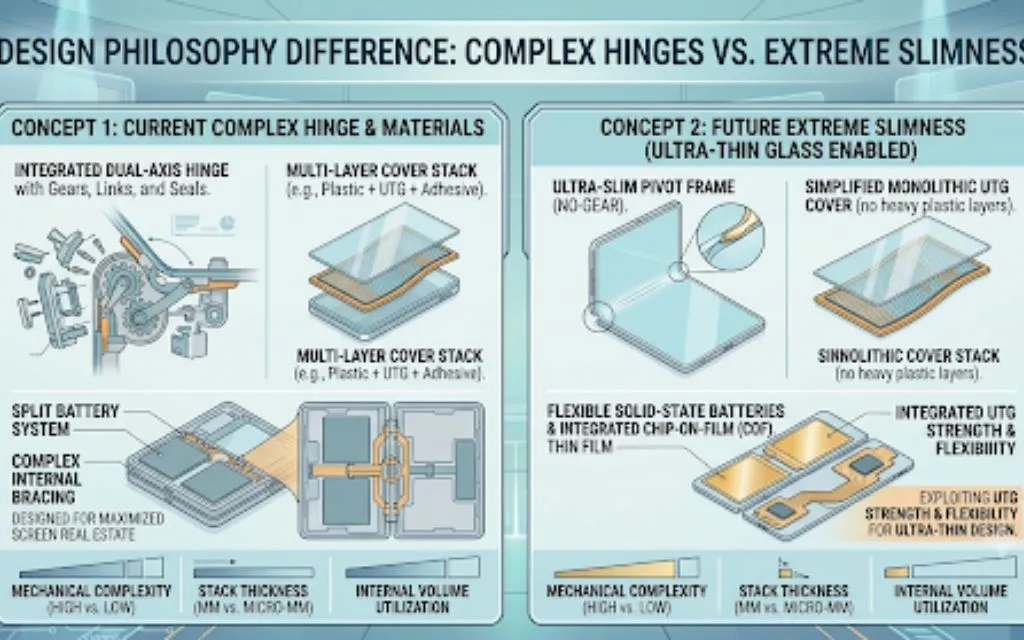
A simple hinge would not be enough because the display needs to bend smoothly without being compressed too sharply. Modern foldable hinges therefore use carefully designed mechanical structures that control the movement of the phone.
Depending on the design, manufacturers may use multi-link mechanisms, water-drop or teardrop-style folding structures, rails and other systems to distribute stress.
The hinge also determines how far the screen bends and how the two halves meet when the phone is closed.
Samsung’s current engineering work shows how the hinge and display cannot be treated as separate components. Its newer foldable designs combine hinge structure, display materials and internal architecture to reduce thickness while managing mechanical stress.
Some hinges can also keep a phone partially open. This allows special modes for photography, video calls and hands-free viewing.
Why Do Foldable Phones Have a Crease?
The crease exists because the flexible display repeatedly bends around the same central area.
When a display folds, different parts of the structure experience different forces. The inside of the bend experiences compression, while other parts experience tension. Repeated movement can make the fold line more visible.
The hinge design can reduce the severity of this bend by creating a larger or more controlled folding radius.
That is why modern foldables can have different crease appearances even when they use similar display technology.
A less visible crease does not necessarily mean that the phone has no folding stress. It usually means the display and hinge have been engineered to manage that stress more effectively.
How Do Foldable Phones Handle Batteries and Heat?
Battery engineering becomes more difficult when a phone has two physical halves.
A manufacturer has to find space for batteries while also fitting:
- the hinge
- cameras
- processor
- memory
- antennas
- cooling hardware
- charging components
- speakers
- flexible cables
Some foldable phones use multiple battery sections distributed across the two halves of the device.
This helps manufacturers use the available internal space while keeping the weight balanced.
Thermal management is also important. A powerful processor can generate substantial heat, but a foldable phone has less freedom for component placement than a traditional smartphone.
This means the internal architecture has to be designed as one system.
Samsung’s 2026 Fold8 Ultra engineering illustrates this approach. The company says its thinner design required coordinated changes to the display structure, materials, hinge, battery and thermal system rather than simply making individual components smaller.
How Does Foldable Phone Software Work?
The physical display is only half of the foldable experience.
The operating system also needs to understand that the device can change shape.
Foldable software can support features such as:
- split-screen multitasking
- multiple app windows
- app continuity
- adaptive layouts
- flex modes
- cover-screen functions
- tablet-style interfaces
For example, a book-style foldable can show a normal smartphone interface while closed and provide a much larger workspace after opening.
Google’s Pixel Fold approach demonstrates how the larger display can support split-screen multitasking, tabletop use, photography and entertainment.
Samsung similarly uses multi-window features to allow users to run multiple applications on the larger display.
This software adaptation is important because simply making a screen larger does not automatically make a phone more useful.
What Are the Main Types of Foldable Phones?
Book-Style Foldables
Book-style phones open from a conventional smartphone shape into a larger tablet-like display.
Examples include the Samsung Galaxy Z Fold family and Google Pixel Fold line.
They are mainly designed for productivity, multitasking, reading, gaming and larger-screen media.
Clamshell Foldables
Clamshell models fold vertically.
When closed, they become much shorter and easier to carry. When opened, they provide a conventional smartphone-sized display.
The Samsung Galaxy Z Flip and Motorola Razr are well-known examples of this design category.
Outward-Folding Phones
An outward-folding design wraps the display around the outside of the device.
This can reduce some crease-related issues because the display does not have to fold inward in the same way. However, the exposed screen can face greater risks from scratches and impacts.
Tri-Fold Phones
Tri-fold technology takes the concept further by using two folding points.
Samsung’s Galaxy Z TriFold demonstrates the direction of this technology. It uses two hinges and opens into a 10-inch main display while retaining a 6.5-inch cover screen. Samsung says the device measures 3.9 mm at its thinnest point when unfolded.
Tri-fold designs could eventually make tablet-sized displays easier to carry, but they also introduce additional mechanical complexity.
Are Foldable Phones Durable?
Durability has improved considerably since the first generation of foldable smartphones, but it remains an important consideration.
A foldable has moving parts that a normal smartphone does not have. The hinge moves, the display bends and several layers experience mechanical stress.
Modern manufacturers use stronger materials, improved hinges, protective layers and water or dust resistance to improve reliability.
For example, Samsung says its Galaxy Z Fold7 and Z Flip7 were certified for up to 200,000 folds under laboratory testing. The same devices also carry an IP48 rating under Samsung’s specified test conditions.
However, laboratory fold-cycle testing should not be interpreted as a guarantee that every phone will last for exactly that number of everyday folds. Real-world conditions can include drops, dust, temperature changes, pressure and accidental impacts.
The safest approach is to treat the folding screen as durable technology that still requires more care than a conventional rigid display.
Advantages and Disadvantages of Foldable Phone Technology
Advantages
Foldable phones can provide:
- larger screens without carrying a separate tablet
- improved multitasking
- compact designs in clamshell models
- flexible viewing angles
- new photography possibilities
- tablet-style productivity
- more screen space for entertainment
Disadvantages
They can also have:
- higher prices
- more complicated construction
- visible display creases
- greater repair complexity
- heavier bodies in some designs
- limited internal space
- more demanding battery and thermal engineering
The technology is improving, but foldables still involve a difficult compromise between thinness, durability, screen size, weight and cost.
What Is the Future of Foldable Phone Technology?
The next stage of foldable technology is likely to focus on making devices thinner, lighter, stronger and easier to repair.
The industry is already moving beyond single-fold designs. Tri-fold phones demonstrate that manufacturers are experimenting with larger screens and multiple hinges.
Another important direction is better integration between hardware and software. As displays become more flexible, operating systems can provide more intelligent layouts that respond to the physical position of the phone.
Materials will also remain important. Manufacturers are working on stronger flexible glass, improved support structures, better hinge mechanisms and thinner internal components.
The broader goal is not simply to make a phone fold. The goal is to make the folding mechanism feel normal while reducing the compromises users notice.
Frequently Asked Questions
How does foldable phone technology work?
Foldable phones combine a flexible OLED display with a specialized hinge and supporting materials. The hinge controls the movement while the flexible display bends around a carefully engineered area.
What makes a phone screen foldable?
A combination of flexible OLED technology, flexible substrates, protective layers and ultra-thin glass makes modern folding displays possible.
Why do foldable phones have a crease?
The crease forms because the display repeatedly bends along a specific area. Hinge geometry and display construction can reduce how visible the crease becomes.
Are foldable phone screens made of glass?
Modern foldable screens can use Ultra Thin Glass along with polymer and other protective layers. The exact construction varies by device.
Are foldable phones durable?
Modern foldables are significantly more durable than early generations, but their moving hinges and flexible screens still require careful handling.
What is a tri-fold phone?
A tri-fold phone has two folding points and can expand into a much larger display than a conventional single-fold smartphone.
Are foldable phones worth buying?
They can be worthwhile for people who value large-screen multitasking, portability, flexible viewing positions or compact clamshell designs. Traditional smartphones may still be better for users who prioritize lower prices and simpler hardware.
Key Takeaway
Foldable phone technology is much more than a flexible screen. It combines flexible OLED, display layers, Ultra Thin Glass, precision hinges, batteries, thermal management, durable materials and adaptive software into one device.
The biggest engineering challenge is balancing flexibility with durability. A good foldable must bend repeatedly without damaging its display while remaining thin, light, powerful and practical.
As the technology moves from single-fold phones toward thinner designs and tri-fold devices, foldable smartphones are becoming a broader form of mobile computing rather than simply a new phone shape.